Turn ambiguous creative scope into visible assumptions, feasible timelines, role capacity, and commercial scenarios—without handing responsibility for the commitment to a spreadsheet.

Role
Collaborators
Scope
Creative estimation often hides consequential assumptions inside individual spreadsheets, personal experience, and hurried conversations. Scope changes ripple unpredictably through hours, fees, staffing, and timelines—making overcommitment easy and learning difficult.
The system needed to support different work models—Campaign, Product, Content, and AI—while preserving a shared commercial logic and clear human ownership over the final commitment.
The prototype begins with a small set of visible inputs: project type, size, review rounds, and complexity. Each estimator translates detailed deliverables into phase totals for Phase 0, Discovery, Concepting, Design Development, and Production or Delivery.
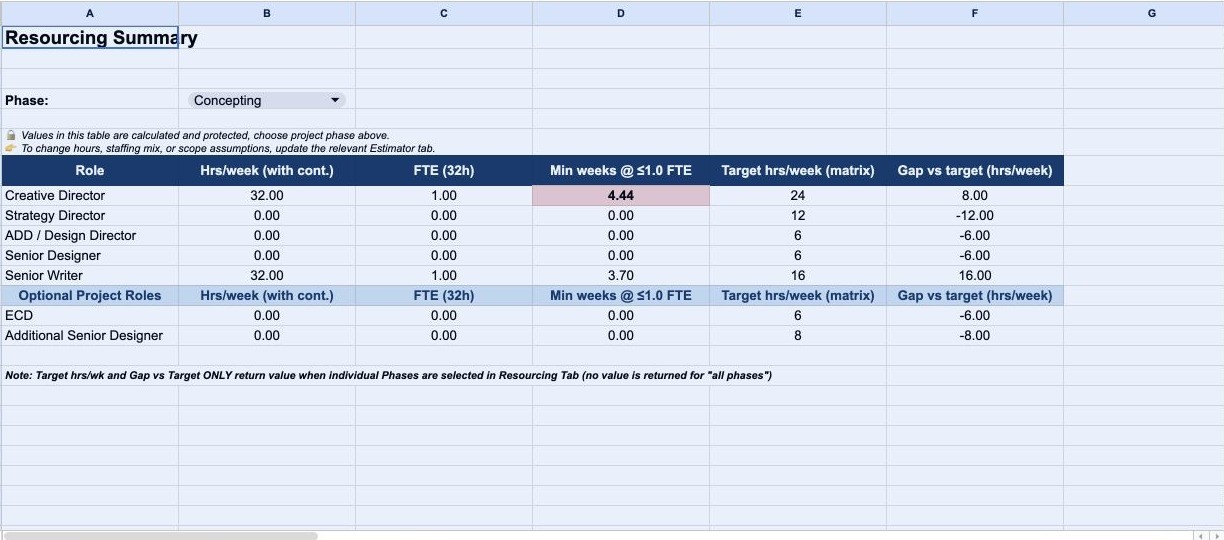
A central engine applies review and complexity factors, fixed-hour assumptions, contingency, blended rates, and role mixes. The dashboard separates minimum feasible timeline from a realistic end-to-end project duration, while the resourcing view exposes workload, FTE, role gaps, and the phase creating the capacity constraint.
Protected logic prevents accidental drift, but editable overrides and documented escalation preserve judgment. The tool makes assumptions inspectable; it does not pretend uncertainty has disappeared.

The result is a repeatable scenario model that connects scope, money, time, and people in one governed flow. Teams can test tradeoffs quickly and discuss the same underlying assumptions instead of reconciling competing private math.
This is an internal prototype. Outcome measurement is the next step; any commercial estimate still requires human review and approval.